Phonecall Review: International Calls From a Browser Tab
A Phonecall review: browser calls to landlines and mobiles in 218 countries, with public rates and no monthly plan.
Sponsored: the company behind this product paid for this article. Links to it are marked as sponsored.
We've tested Phonecall, a browser calling service that dials real landlines and mobiles in 218 countries without a SIM, an app, or a monthly plan.
Welcome to this Phonecall review.
There's a specific kind of stuck that only happens when you're traveling, or working somewhere your phone has data and nothing else. The airline, the clinic, the hotel front desk, your bank: they still answer a normal phone number. WhatsApp and FaceTime only reach people who also have the app. Roaming voice, when it works, is priced like a punishment. Skype, the old default for "call a real number from a computer," is gone.
Phonecall (phonecall.app) is a narrow answer to that. Sign in, put a few dollars on the account, type a number, and the other person picks up an ordinary phone. No download. The call rides your internet connection out, then lands on the regular phone network.
I walked the public site (homepage, rates, pricing estimator, FAQ) and reviewed a signed-in account: the dialer, the account page, and the buy-credits screen. I did not place a completed paid call from this environment, so call quality and exact mid-call billing are described from the product surface and the published rate card, not from a long conversation I sat through.
Getting in is a top-up, not a subscription
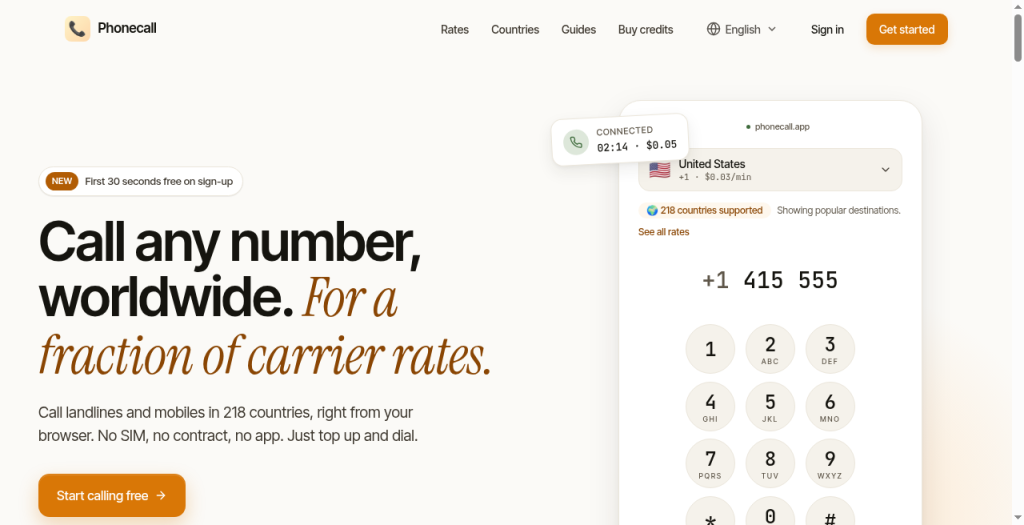
The contract is stated before you commit. A badge on the hero says the first 30 seconds are free on sign-up. Under the headline: landlines and mobiles, no SIM, no contract, no app. The site says calls are powered by Twilio, encrypted in transit, and billed per second.
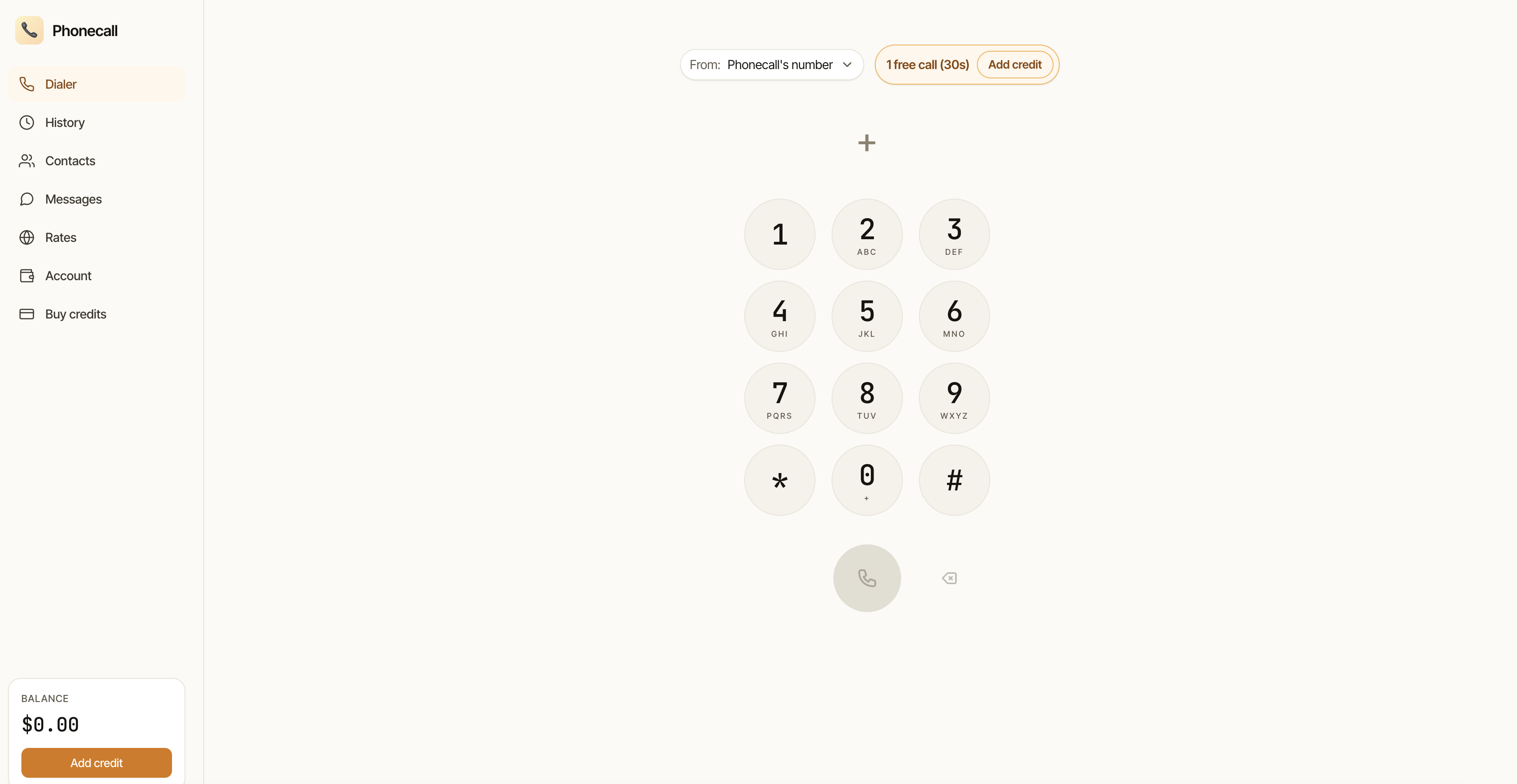
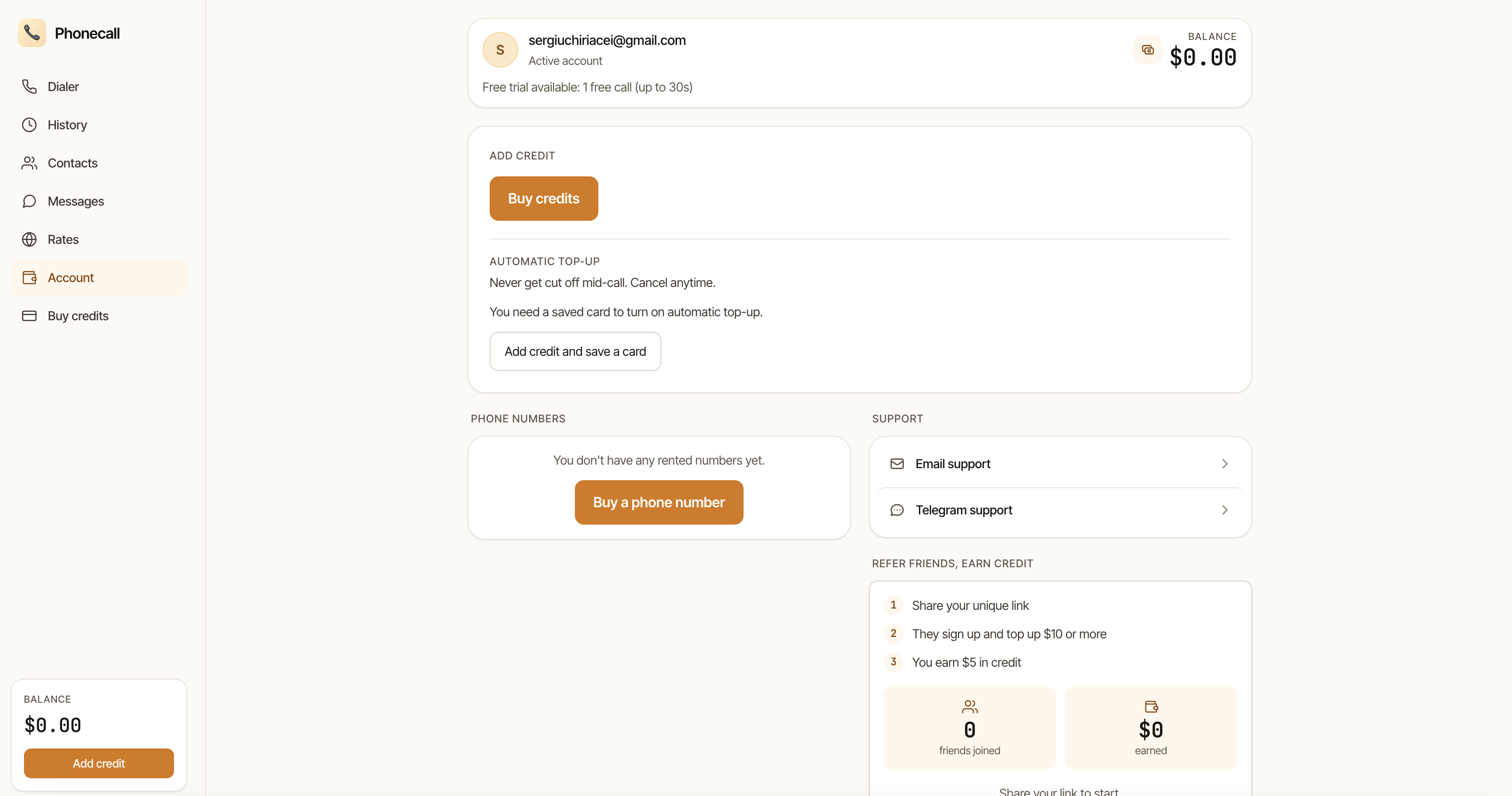
Inside a real account, that free slice shows up as one free call, up to 30 seconds, placed from Phonecall's own number. Balance on the account I looked at was $0.00, with a clear Add credit path. Sign-in is Google or email. There is no app store step.
The dialer is the whole product
Once you're in, the left nav is short: Dialer, History, Contacts, Messages, Rates, Account, Buy credits. The dialer is a keypad, a country/rate line, and a call button. The marketing version of the same screen shows the destination and the per-minute price before you dial (United States at $0.03/min in the homepage mock), plus a live cost while connected.
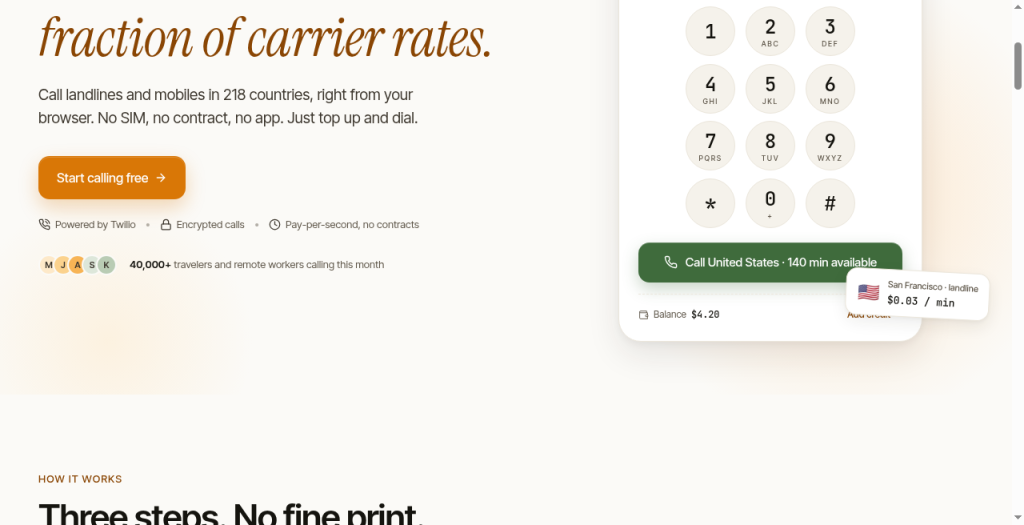
That is the correct shape for this job. You are not configuring a PBX. You are placing one call.
The account page sits next to it: balance, add credit, automatic top-up (off until you save a card), rented phone numbers (none yet), email and Telegram support, and a refer-a-friend block ($5 credit if someone signs up and tops up $10 or more).
Three steps, and they really are three
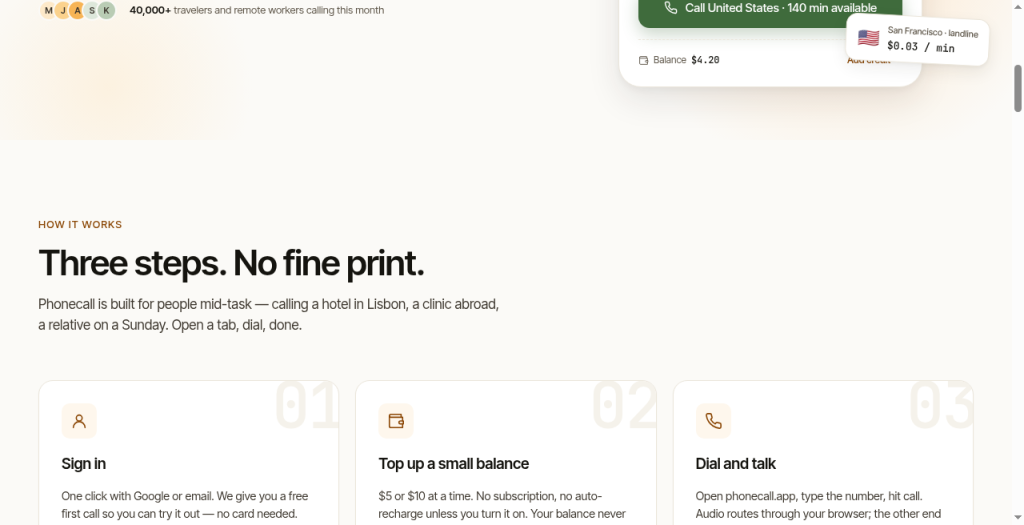
The site's how-it-works is not a funnel with a hidden fourth step.
- Sign in with Google or email. The first call is free, no card.
- Top up a small balance. $5 or $10 is the pitch. No subscription, and auto-recharge stays off unless you turn it on. They say the balance never expires.
- Dial. Audio goes through the browser. The other end rings as a normal phone call.
Around that, the feature grid is practical rather than flashy: sub-second setup claimed over their network, TLS from the browser to Phonecall (then handed to carriers like any other call), 218 countries, HD voice via Opus at 48 kHz when both ends support it with a G.711 fallback, per-second billing with an emailed receipt, Chrome/Safari/Firefox plus install-as-PWA, searchable history with CSV export, and a shared team credit pool with per-seat reporting.
Rates are public, and they are not one number
This is the part worth actually reading, because "a fraction of carrier rates" is true on some routes and much less dramatic on others.
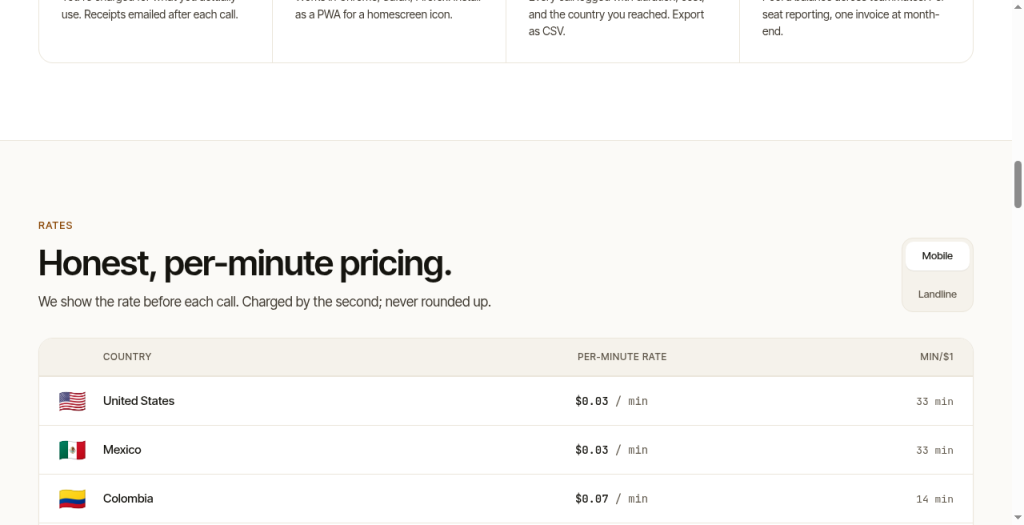
The homepage table, which matches the public rate card I checked, lists mobile rates such as:
- United States, Mexico, Canada: $0.03/min
- United Kingdom: $0.06/min
- South Korea: $0.07/min
- India: $0.08/min
- Italy: $0.10/min
- Colombia: $0.07/min
The full card goes much wider. Australia is about $0.15, France about $0.32, Germany about $0.75, Portugal about $0.99, Philippines about $0.46. A few destinations are genuinely expensive (Algeria around $2.69/min, some island routes several dollars a minute). The rate page says the figure you see before you dial is the one you pay, mobile and landline can differ, and rates can move with carrier agreements.
There is a small wording tension worth knowing. The marketing rates block says you are "charged by the second; never rounded up." The rates FAQ says the call is billed for connected time at the per-minute rate and the total is rounded up to the nearest cent. Those can both be roughly true (per-second math, then a one-cent round-up) but they are not the same sentence. Check the live rate on the dialer before a long call to a pricey country.
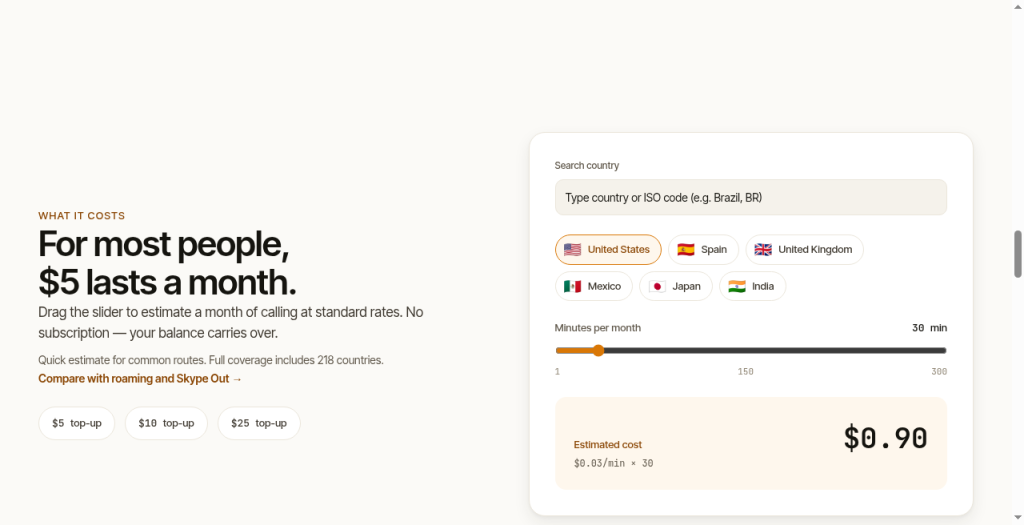
An on-site estimator makes the cheap routes obvious: 30 minutes to the United States at $0.03 comes out to $0.90. Five dollars really can last a month if that is the kind of calling you do. It will not last a month of calls to a $1/min mobile.
Buying credit is a pack, not a plan
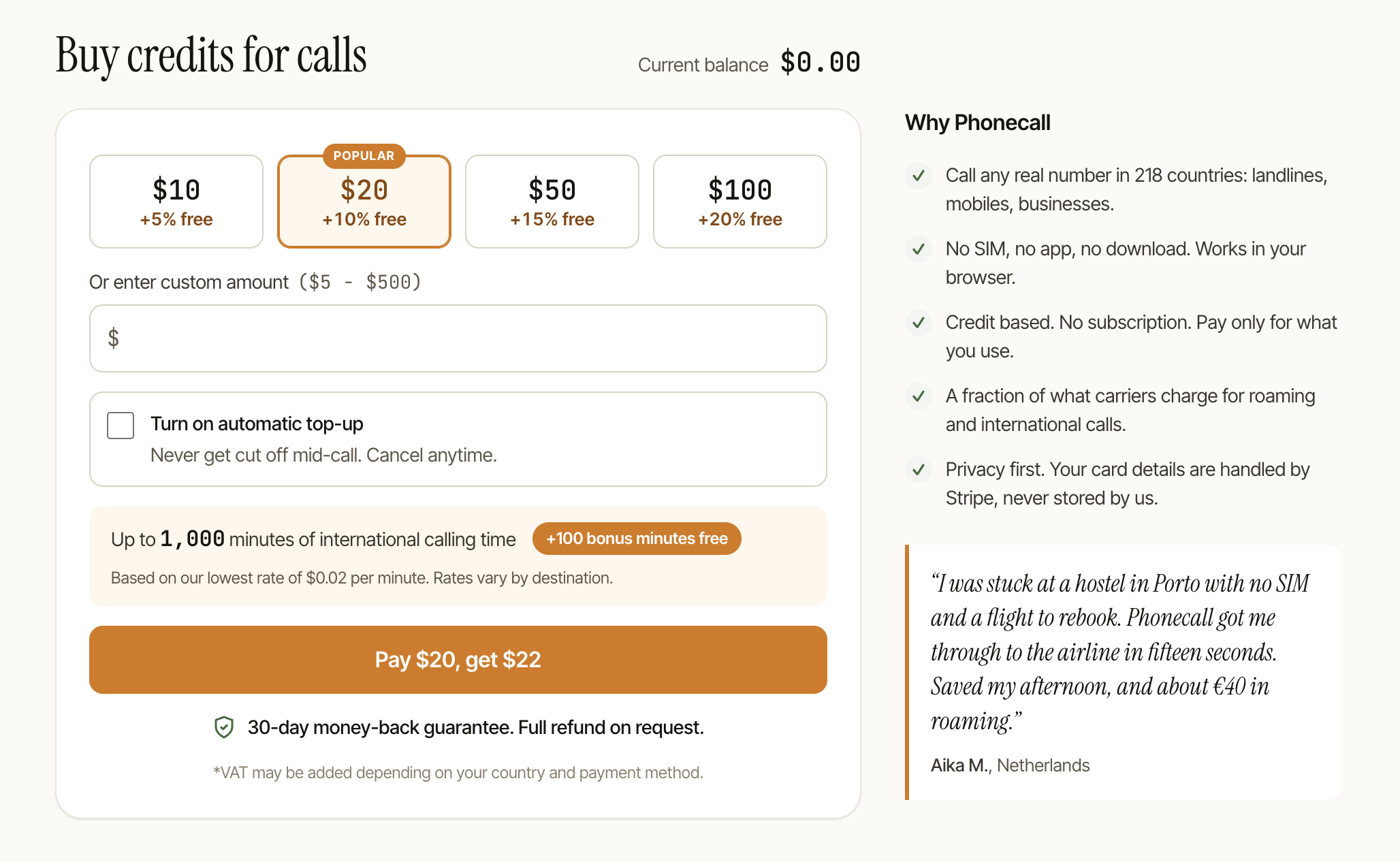
The signed-in buy-credits screen is clearer than a lot of telecom checkout pages. Balance sits at the top. Packs are $10 (+5% free), $20 (+10% free, marked popular), $50 (+15%), and $100 (+20%). Custom amounts run from $5 to $500. A $20 purchase is labeled "Pay $20, get $22."
Automatic top-up is a checkbox, off by default, with the line "Never get cut off mid-call. Cancel anytime." The page also translates the cheapest published rate into time: up to 1,000 minutes of international calling based on $0.02 per minute, with the caveat that rates vary by destination. There is a 30-day money-back line ("full refund on request") and a note that VAT may be added depending on country and payment method. Card handling is attributed to Stripe, not stored by Phonecall.
I did not complete a purchase.
What it is not
Phonecall is not a messenger. The person you call does not install anything, which is the point, and also the limit: you cannot "Phonecall" someone the way you WhatsApp them unless they have a normal number.
It is also not end-to-end encrypted in the messaging-app sense. The site's own language is TLS from your browser to their network, then a normal handoff to carriers. That is encrypted in transit on their side of the hop, not a private tunnel all the way to the other person's handset.
Inbound is a separate product surface. The account I saw had no rented number and a "Buy a phone number" button. Outbound by default uses Phonecall's number as caller ID. I did not test whether someone can call that number back.
Team pooling, CSV history, and HD codec fallback are listed on the marketing site. I did not exercise them on a live call.
Who should use it
- Travelers on a data-only eSIM or hotel Wi-Fi who still need to reach a landline or a local mobile
- Remote workers calling banks, clinics, hotels, or clients that do not live in a chat app
- Anyone making occasional calls to cheap routes (US, Canada, Mexico, UK, India) who does not want a monthly international plan
- People who want a browser tab instead of another phone app, including a homescreen PWA
- Small teams that want one shared balance instead of personal roaming bills
Who shouldn't bother: if everyone you call is already on WhatsApp or FaceTime, this is the expensive way to do a free thing. If your destinations sit at the top of the rate card, do the math first; a dollar a minute is not a rounding error. And if you need a permanent local number, voicemail, and people calling you all day, you are shopping for a phone number plus a calling plan, not just a dialer. Phonecall can rent a number, but that is an add-on I did not buy.
FAQ
Do I need to install an app?
No. It runs in the browser (Chrome, Safari, Firefox are the ones they name). You can install it as a PWA if you want a homescreen icon. Microphone permission is required to actually talk.
How does billing work?
You prepay credits. The rate is shown before the call. Marketing copy says billing is per second. The rates FAQ says the total is rounded up to the nearest cent. Purchased balance is described as never expiring. There is no monthly subscription unless you opt into automatic top-up.
Is the first call really free?
The site advertises the first 30 seconds free on sign-up, with no card. The signed-in dialer I reviewed showed "1 free call (30s)" on a $0 balance.
Can people call me back?
Outbound calls in the account I saw were placed from Phonecall's number. Renting your own number is a separate purchase on the account page. I did not test inbound calling.
Is it end-to-end encrypted?
Not in the way chat apps mean it. Phonecall says the browser hop is encrypted (TLS) and the audio is then handed to carriers like a normal phone call.
What if I run out of credit mid-call?
Automatic top-up exists and is off until you save a card and turn it on. The pitch is that it keeps a call from dying. I did not test a mid-call cutoff.
How much are international calls?
It depends on the country and on mobile vs landline. Published examples: United States $0.03/min, United Kingdom $0.06/min, India $0.08/min, Italy $0.10/min. Other countries run from a few cents to several dollars a minute. The dialer is supposed to show the live rate before you call.
Conclusion
Phonecall does a simple job with a simple interface: put credit on an account, dial a real phone number from a browser, pay for the seconds you use. The signed-in product matches that story. The dialer, the $0 balance with one free 30-second call, and the credit packs are all obvious. The public rate card is the part that decides whether it is cheap.
What I liked:
- No app, no SIM, no subscription. A browser tab and a balance
- A real free first call (30 seconds) with no card, visible in the signed-in dialer
- Rates published before you dial, with a country estimator on the homepage
- Credit packs with a stated bonus, auto top-up off by default, and a 30-day refund line
- Balance described as non-expiring
- Useful edges if you need them: call history, contacts, message entry in the nav, number rental, email and Telegram support
- Honest positioning against app-to-app chat: the other person just answers a phone
Things to keep in mind:
- "Cheap" is route-specific. US/UK/India are inexpensive; plenty of countries are not
- Per-second billing and "rounded up to the nearest cent" are both on the site; read the live rate
- Encryption is in transit to Phonecall, then a normal carrier call, not end-to-end
- Inbound calling looks like a rented number, not something you get by default
- I reviewed the product surface and the rate card; I did not complete a long live call, so voice quality is not something I can score from experience
Try it: https://phonecall.app/en-us/
Done for you
We submit your SaaS to 100+ directories
Skip the forms. We manually list your product on 100+ directories and send a report with a screenshot of every submission.
- Manual submission to 100+ directories
- Save 60–90+ hours of manual work
- Detailed report with screenshots of every listing
- Hand-picked free and paid directories
- More visibility and brand reach
- Including Crunchbase, StackShare, SaaSHub, and more